
The B.C. logging industry has a problem: we’re running out of trees. In the last twenty years, at least forty-four mills have closed with the standard explanation being a reduction in the supply of “fibre” – otherwise known as trees. This isn’t simply due to the export of raw logs, although that is a big factor. The problem is a decline in economically harvestable trees. The timber harvest in BC dropped from 68 million cubic metres in 2015 to 35 million cubic metres in 2025. This was one of the many troublesome statistics presented at the New Forest Act Roadshow event held at the Stan Hagen Theatre on June 15th.
Jennifer Houghton, the Campaign Director for the Boundary Forest Watershed Stewardship Society (BFWSS), was the main presenter at the event. Houghton lost everything in the Grand Forks flood of 2018. In the aftermath, she began asking questions about the causes of the flood. She needed to understand what had happened and why it had happened. What she discovered, in a nutshell, is that provincial forest legislation is designed to facilitate the flow of timber. It is not designed to protect watersheds or the property, people and ecosystems within those watersheds. Houghton and a group of dedicated volunteers set about to change that.
They quickly realized that tweaking and trying to fine tune the existing patchwork of legislation related to logging was not going to work. So, they sat down and wrote a comprehensive and detailed piece of proposed legislation. They are calling it The New Forest Act. They believe that if they can create enough support in the public sphere to get the legislation passed, that it would be the answer to both our declining forests and the devastating loss of jobs in the industry.
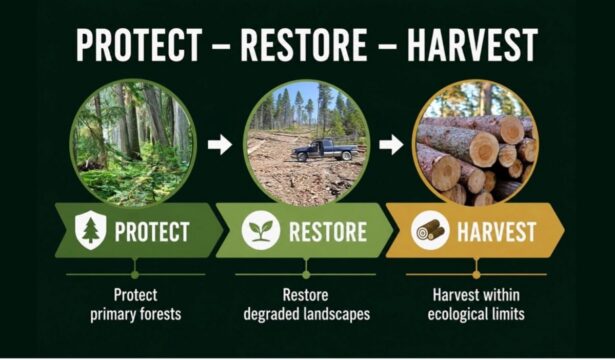
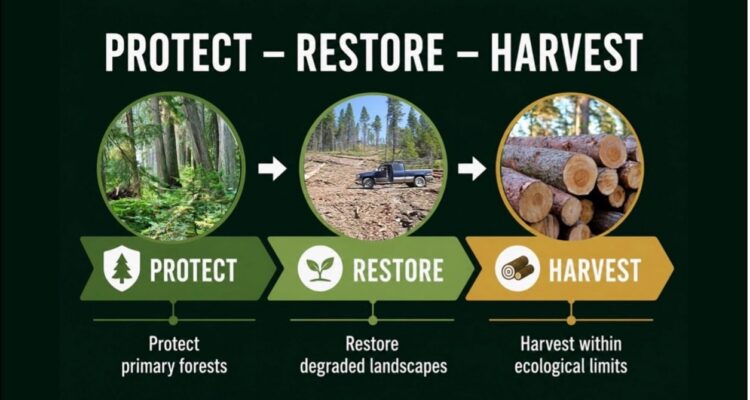
The New Forest Act proposes a forestry framework called PRH: Protect, Restore, and Harvest. The first component is simple: PROTECT old growth trees. Stop all logging of primary (old growth) forest. Period. No exceptions. The RESTORE piece addresses damage done by current logging practices and in the process creates jobs. These new jobs will entail removing roads, hydrological repair, watershed restoration, etc. And finally, HARVEST will mean selection-based logging on previously logged lands.
A new Ministry of Ecosystem Integrity (MOEI) would administer the Act with Indigenous and public leadership. Community Forest Boards would make local decisions. A key component of the proposed legislation is the introduction of community log sorts. Logs will be made available at market rates to stimulate the creation of small local mills and manufacturing. This will end the current process that favours exporting logs as opposed to keeping them, and the value they represent, here in BC.
The proposed Act is a turn-key package that, once passed by the legislature, could be put into effect immediately. BFWSS has developed far reaching and detailed plans to support implementation. Plans include transition strategies, training programs, ministry reorganization, and oversight schemes. What is needed now is to get as much citizen support as possible.
There were no representatives of the logging industry in evidence at the presentation so we can only speculate what their reaction might be. But Cumberland mayor, Vicky Brown, who attended the roadshow event, pointed out the level of influence that logging industry has in government. She said her office meets with the Minister of Forests once a year, but industry representatives meet with the Ministry ONCE A WEEK. Brown suggests that everyone who supports the new Act should personally call the Minister’s office once a week to ensure our voices are heard over the corporate interests.
I would encourage everyone to have a look at the proposed Act. (https://boundaryforest.org). If you feel, as I do, that this is a timely fix to the problems with BC’s forests, then by all means, pick up the phone!
Author: Mike Mesford, BWS President