

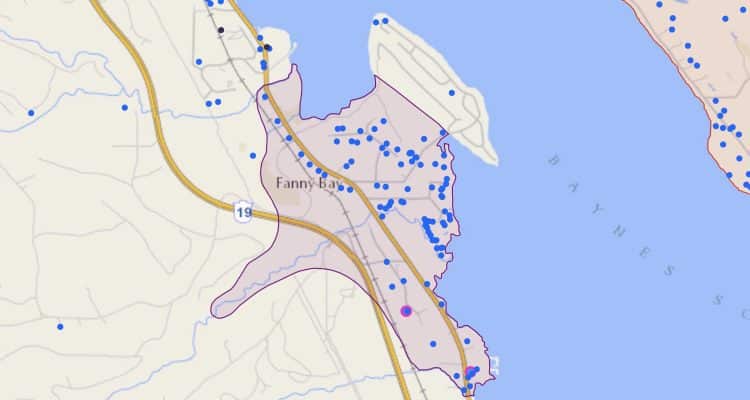
Last month I got an email from a neighbour telling me his old, unused well had dried up a month earlier than it did last year. I talked to another neighbour in Fanny Bay who said their well had gone dry for the first time in over thirty years. There is plenty of anecdotal evidence that the water table is lower this year than previously. A quick peek at the data that BWS has collected in recent years from wells in Fanny Bay confirms the anecdotal evidence. Groundwater is lower than in recent years. Given our relatively dry winter and the extremely low snowpack this makes sense. We need to understand how conditions like these will affect us in the future.
So, BWS’s most recent collaboration with the University of Victoria School of Earth & Ocean Sciences (SEOS) couldn’t come at a better time. At the end of September, an undergraduate student will study Aquifer 419 which is presumed to extend between Waterloo Creek and Cowie Creek. She will be supervised by Mike Wei, P.Eng., a hydrogeologist with 40 years’ experience working on groundwater management and Lucinda Leonard, Ph.D., a geophysicist and an Associate Teaching Professor with SEOS. Both Dr. Wei and Dr. Leonard have worked with BWS for the past three years on our aquifer mapping projects.
They will be using techniques outlined in a recent research paper (“Exploring Methods for Setting Groundwater Allocation Extraction Limits and Improving Understanding of Hydraulic Connection in B.C.” by Sivak et al. 2024). The goal is to estimate the amount of groundwater available from the aquifer. If feasible, the issue of saltwater intrusion will also be considered.
BWS is looking for well owners who will allow us to take a one-time water level and water quality measurement during the first phase of the project. If you would like to participate, we will arrange a visit to inspect your well prior to the researcher’s arrival. Please contact director.tech@beaufortwater.org.
The researchers are using this an opportunity to test the techniques developed in the above-mentioned research paper. However, from our community’s perspective, it’s a fabulous opportunity to explore the complex puzzle that is our aquifer. The researchers have cautioned us that we may not get clearcut answers. But it will undoubtedly raise new questions which is always good—that’s how science progresses.
One way or another, we will know more at the end than we do now.