
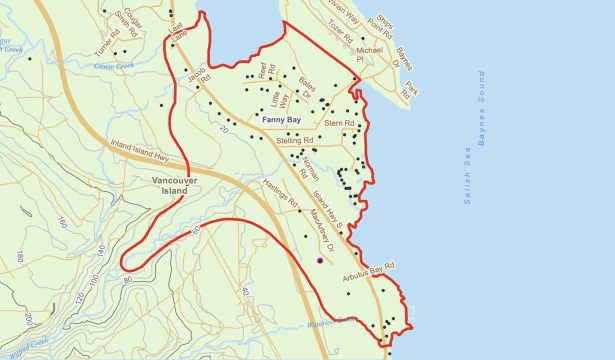

Source: Aquifers Online apps.nrs.gov.bc.ca/gwells/aquifers. 2025-03-25
The Beaufort Watershed Stewards (BWS) will once again be working with a student from the University of Victoria School of Earth & Ocean Sciences (SEOS) to learn more about one of the aquifers that provide all of our fresh water on the eastern slopes of the Beaufort Range. The student is planning to collect groundwater level and water quality data from wells on Aquifer 419 (see map above), located in Fanny Bay (planned for the last week of August). Both Fanny Bay and Ships Point community wells are in this area along with numerous private wells.
The undergraduate student’s project goal is to characterize the hydrogeology of Aquifer 419 and develop preliminary estimates of the amount of extractable groundwater from the aquifer, by applying the various techniques outlined in “Exploring Methods for Setting Groundwater Allocation Extraction Limits and Improving Understanding of Hydraulic Connection in B.C.” by Sivak et al. (2024). If feasible, the issue of salt water intrusion given the aquifer’s proximity to the ocean will also be considered.
The student is being co-supervised by Mike Wei, P.Eng., a hydrogeologist who has 40 years’ experience working on groundwater resource management in BC and adjunct staff at SEOS, and Lucinda Leonard, Ph.D. a geophysicist with SEOS. Both Dr. Wei and Dr. Leonard have worked with BWS for the past three years on our aquifer mapping projects.
If you have a private well in this area and would like to participate in the study, we are looking for wells that we can access for a one-time water level and water quality measurement during the end of summer. Please contact us at info@beaufortwater.org. We will collect your information and arrange a visit to locate and inspect the well prior to the student undertaking any measurements. We will also be at the Fanny Bay Market on August 9 to answer questions about the project.
This study will be one more step in understanding the status of our water supply. It will answer some questions, probably raise new ones, but add one more piece to the complex puzzle of understanding the state of our groundwater resource.