
There’s something that’s been bugging us. We know quite a bit about our streams. We regularly measure their temperature, turbidity, specific conductance, pH, and oxygen content. When we’re sampling, we take note of frogs or salamanders that cross our path and birds that depend on the creeks for food (a lot of American Dippers and Kingfishers). We make comments in our logbook about particularly lush vegetation or pretty flowers. We note the presence of caddis fly larva, an important food for young salmonids.
But there’s a lot more going on in these creeks than even a seasoned sampler might notice. There are bugs. Or to be a bit more scientific, invertebrates. Their numbers and variety are arguably more indicative of stream health than the five physical markers we regularly measure.
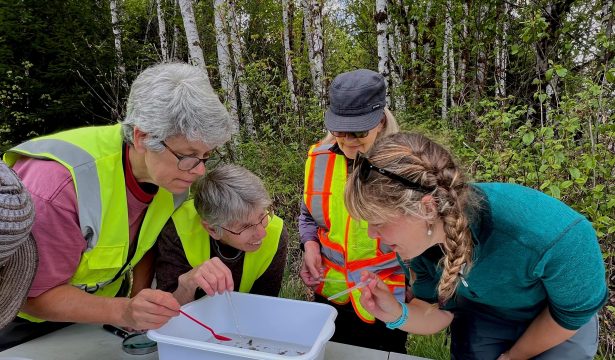
So how can we measure this important indicator of stream health? That’s what’s been bugging us. You can’t stick a probe in the water and read the results on a screen like we do for other parameters. In order to measure the bugs, you need to get down and dirty with the little critters in their gritty habitat. Which is exactly what we did. With the generous financial support of the Comox Valley Community Foundation, we were able to fund enrollment for several BWS volunteers in a Pacific Streamkeepers Federation course. Michelle introduced us to the techniques of benthic invertebrate surveying. “Benthic” as all the Greek scholars in the audience will know, comes from βένθος, meaning “bottom of the sea”. In modern usage, benthic refers to the bottom of a river or a lake or, in our case, a streambed.
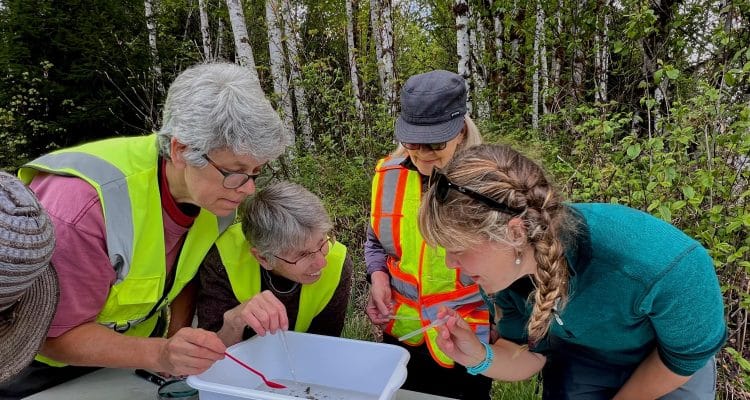
It was truly fascinating to see just how much life there was squiggling around in the sand and under the rocks in our little creeks. Washing just a handful of gravelly sand through a sieve revealed a writhing mass of life which we carefully teased apart and put in trays. Then, with the help of the instructor, an aquatic biologist, and a local entomologist, each creature was identified, sorted, and counted before it was gently returned to its home.
We now have a benthic baseline for a number of the streams that we already monitor. We will sample selected streams in spring and fall to capture very different life cycle stages and stream conditions. Our data will be shared with Streamkeepers Federation and be openly accessible online. Over time, as we do additional benthic surveys, we will be able to identify trends in stream health in a much more comprehensive manner.
Now, knowing what we know about the number of critters living in the streambed, we feel compelled to step gently when sampling and measuring. You may hear us if you pass by as we tip-toe through the water. “I beg your pardon! Coming through! Sorry! Excuse me!” The benthic community will, I’m sure, appreciate our newfound politeness.